Confidence Scoring in Document Extraction

Every extracted field comes with a number attached — 0.98, 0.71, 0.34 — and that number, not the extracted value itself, is what actually runs a production document pipeline. Confidence scoring in document extraction decides which fields flow straight through to a downstream system untouched and which stop for a person to look at first. Get it right, and a review queue holds only the documents that genuinely need a human. Get it wrong, and a team either drowns in manual review or ships errors it never sees coming — and for high-risk AI use cases, this is no longer a purely operational choice: human oversight of exactly this kind is now a legal requirement under the EU AI Act.
What Is Confidence Scoring in Document Extraction?
Confidence scoring in document extraction is the process of estimating, per field, how likely an AI model's output is to be correct — the 0.97 beside a correctly-read invoice total, the 0.61 beside a smudged handwritten date — so a pipeline can route each field automatically rather than treating every extraction as equally trustworthy. A raw model probability is a poor version of this signal on its own: neural networks are well documented to be systematically overconfident, especially on inputs unlike their training data — exactly when they're most likely to be wrong. Production-grade confidence scoring instead fuses several signals — calibration against held-out ground truth, agreement across repeated reads, input-quality features like blur and skew, and validation checks like format and checksum matches — into a score that's actually been tested against how often it's right.
The number is only useful in service of a decision: below a confidence threshold, a field routes to a human; at or above it, the field flows downstream untouched. That threshold, and how well the score is calibrated to it, is where most of the real engineering — and most of the real disappointment — in this space actually lives.
How Do Confidence Thresholds Decide What Gets Automated?
The Precision–Recall Trade-off
Every threshold is a trade-off, not a judgment call a vendor can optimize away: set the bar high and precision improves — fewer wrong answers slip through — but recall drops, pulling more borderline-but-correct fields into review. Set it low and automation climbs, but so does the rate of confidently wrong answers reaching a downstream system untouched. There's no threshold that maximizes both; there's only the one that matches how much residual error a specific workflow can tolerate, which is a compliance decision as much as a modeling one.
Why a Single Threshold Doesn't Work Across Document Types
A single global threshold is close to guaranteed to be wrong for most of a document population, because error rates aren't uniform across document types or capture channels. A threshold tuned on clean, digitally-generated invoices lets through far more errors on faxed claims forms or handwritten fields than the same number implies — a 0.90 score means something different depending on what it was measured against. Thresholds that hold up in production are set per document type and field, not once for the whole pipeline, and revisited as the document mix shifts.
Why Do Confidence Scores Erode Trust After Deployment?
The failure mode that actually shows up in production isn't a bad initial threshold — it's one that drifts out of alignment with reality after go-live. As one detailed industry analysis of confidence score reliability in document extraction puts it, operations teams often discover within the first two weeks of deployment that reported confidence doesn't track actual accuracy — and once that happens, they stop trusting the threshold and quietly go back to reviewing everything, erasing the automation gain the system was bought to deliver. The same analysis frames what "calibrated" should mean concretely: at a reported 99% confidence, the real error rate should sit at or below 1%; at 95%, near 5% — holding consistently across document types, not just on a demo set. Few vendors show that calibration curve, which is exactly why it's worth asking for one before rollout.
What Do Reviewers Actually See When a Field Is Flagged?
How vendors architect human-in-the-loop verification varies more than the marketing copy suggests. Gartner's own Peer Insights coverage of the intelligent document processing market — the same market its inaugural Magic Quadrant for IDP began formally rating in September 2025 — describes how Hyperscience's platform involves employees "only when the software is not confident enough to meet the accuracy Service Level Agreements predefined by the customer," putting the SLA itself, not a fixed model score, at the center of routing. That's a meaningfully different design than a static per-field threshold — the kind of detail that only surfaces once you ask a vendor to walk through actual routing logic rather than a headline automation-rate number.
What Does EU AI Act Article 14 Actually Require for Human Oversight?
Most vendor content treats confidence-based routing as a pure efficiency mechanism — spend human attention where the model is unsure, automate the rest. For a bank, insurer, or lender operating in the EU or UK, it's also a compliance obligation. Article 14 of the EU AI Act requires high-risk AI systems be designed so they "can be effectively overseen by natural persons," and goes further than a general "human in the loop" instruction: people assigned oversight must be able to "understand the relevant capacities and limitations" of the system, "detect and address anomalies," and — notably — "remain aware of the possible tendency of automatically relying or over-relying on the output" of the system, what regulators call automation bias.
That last requirement is the one confidence scoring speaks to directly. A reviewer who sees a bare "0.94" next to a field, with no visibility into what drove that number or how often it's historically been right, is in exactly the position Article 14 is written to prevent: nominally overseeing a decision with no real basis to question it. A KYC packet, loan file, or claims bundle processed this way is squarely the use case regulators are targeting — which makes calibrated, explainable confidence scoring the control that lets an institution document its human oversight is real, not theater.
How Does Confidence-Based Routing Work in a Regulated Pipeline?
In a KYC, claims, or lending pipeline, confidence-based routing turns field-level scores into a workflow: a high-confidence field — a cleanly printed account number that also passes a checksum — flows straight into the KYC or loan underwriting system untouched. A mid-confidence field might get a second automated pass before a decision is made. A genuinely uncertain one, flagged through low-confidence flagging, lands in front of a person with the specific region of the page highlighted, rather than the whole document handed back for a cold re-read — the same targeting principle that lets agentic document extraction concentrate its self-correction effort where it's actually needed.
Why Does Field-Level Confidence Matter More Than Document-Level Accuracy?
A single accuracy number for an entire document — "98% accurate" — hides exactly what a compliance function needs to know, because it says nothing about which 2% was wrong or how much that mattered. A claims file with a perfectly extracted policy number and a wrong loss amount isn't 98% correct in any sense a claims adjuster would recognize; it's wrong on the field that decides the payout. Field-level confidence scoring is what makes a review queue targeted instead of a coin-flip: attention goes to the loss amount specifically, not to re-checking a document that extracted cleanly everywhere else.
This is also where deployment environment stops being a side detail. Every low-confidence field that triggers a second read or an escalation is another pass over the same sensitive customer or claimant data as the original document — so the confidence-scoring loop itself needs to run somewhere an institution actually controls. Proof Perimeter's fine-tuned document AI models run field-level confidence scoring, calibration, and the resulting review-queue routing inside a bank, insurer, or lender's own environment — cloud-hosted, within customer infrastructure, or fully on-premise on commodity CPUs — with provenance attached to every score, so a reviewer sees what drove it, not just a number. On Proof Perimeter's internal benchmarks, that fine-tuned model delivers 20% higher accuracy and 50% lower token consumption than general-purpose frontier models on the same document-extraction tasks — meaning fewer fields need a human second look at all, not just a better-organized queue for the ones that still do.
How Do You Evaluate a Vendor's Confidence Scoring Claims?
- Ask for a calibration curve, not a single accuracy number. At 95% reported confidence, does the real-world error rate sit near 5%, measured against your own documents?
- Ask whether thresholds are set per document type, or globally. A single blended threshold is a warning sign for any document mix with real variety.
- Ask how confidence is monitored after go-live. Calibration drifts as document populations shift; a vendor with no recalibration process is asking you to trust day-one numbers indefinitely.
- Ask what a reviewer actually sees when a field is flagged. A highlighted region and a stated reason is a different oversight experience than a bare number.
- Ask where the scoring and re-read logic physically runs. Every low-confidence escalation is another pass over the same sensitive document.
Most vendors will walk through their actual calibration data and routing logic on a demo call if you bring documents from your own mix, including the ones you already know are borderline.
Frequently Asked Questions
What's a good confidence threshold for document extraction?
There isn't a universal number — it depends on how much residual error a specific field and workflow can tolerate, and should be set per document type rather than globally. What matters more is whether it's been validated against real accuracy on your own documents, not a demo set.
Does a high confidence score guarantee a correct extraction?
No. A high score means the model's calibration estimates the extraction is likely correct, not that it's certain. Confidence scoring reduces how often review is needed — it doesn't eliminate error, which is why high-confidence fields in high-stakes workflows sometimes still warrant spot-checking.
Is human review still required if confidence scoring is accurate?
Yes — for any flagged field, and under EU AI Act Article 14, for high-risk use cases more broadly. Accurate scoring changes how much review is needed and where it's targeted, not whether oversight is required at all.
The Takeaway
Confidence scoring in document extraction is the control layer that decides whether human review is a targeted, sustainable practice or a queue nobody trusts. The number attached to a field matters less than whether it's been calibrated against real outcomes, tracked separately by document type, and revisited as the document mix changes — and, increasingly, whether the humans looking at flagged fields can actually understand and question what they're seeing, which is precisely what regulators are now starting to ask for directly.
What Is Agentic Document Extraction?
Agentic document extraction adds a self-correcting reasoning loop OCR never had — catching its own errors before they reach a regulated workflow.
What Is OCR AI? A Plain-Language Guide
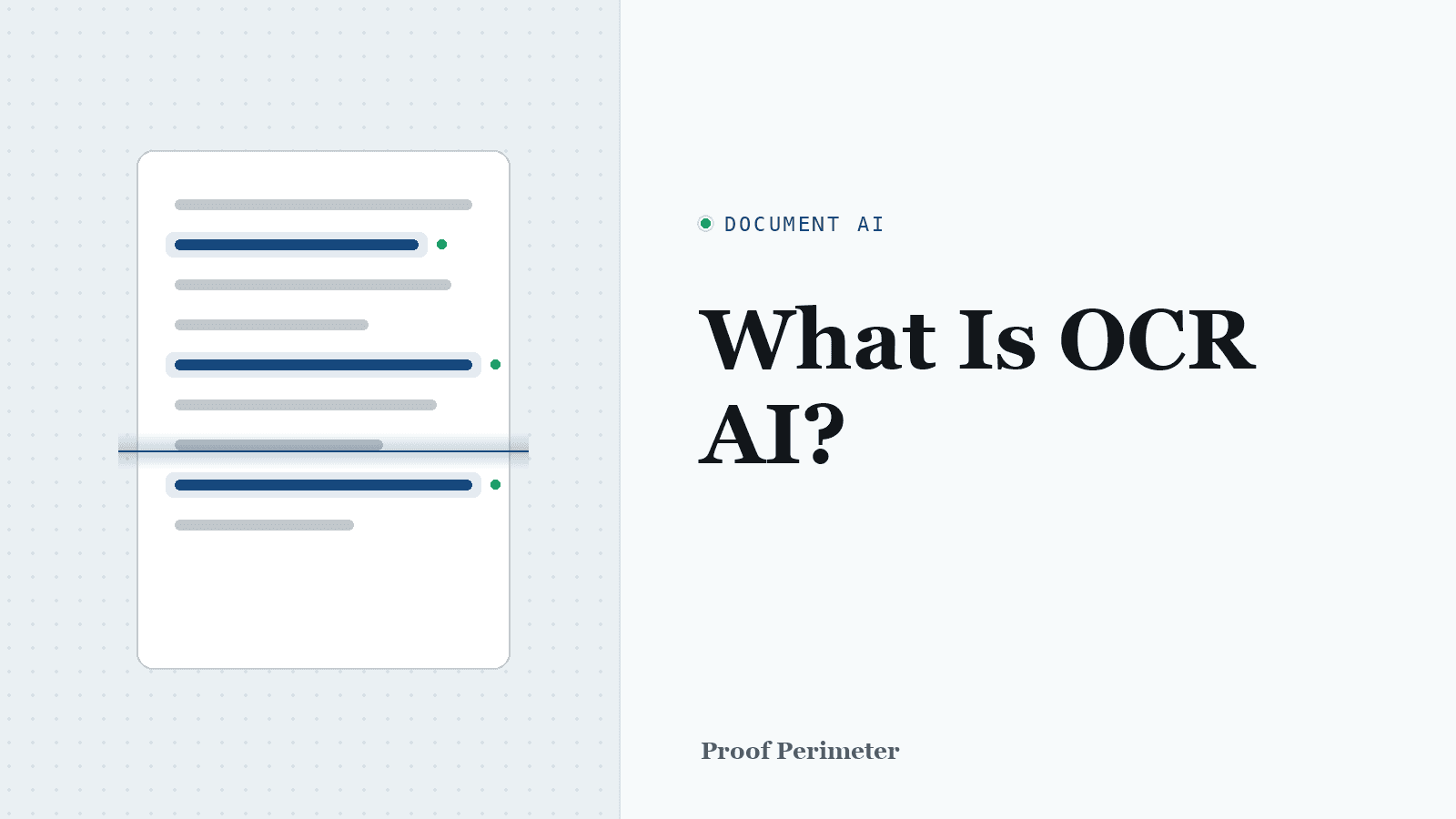
OCR AI combines optical character recognition with machine learning to read, understand, and extract structured data from regulated, document-heavy workflows.
Document Classification AI Guide
Document classification AI sorts KYC packets, claims bundles, and loan files by type before extraction — where it breaks is the training-data problem.
Proof Perimeter runs document AI inside your own perimeter — with a provenance record on every field.
Get Started for Free